Arm Optimize™ Program
The 6 Pillars
A functional approach to upper extremity recovery
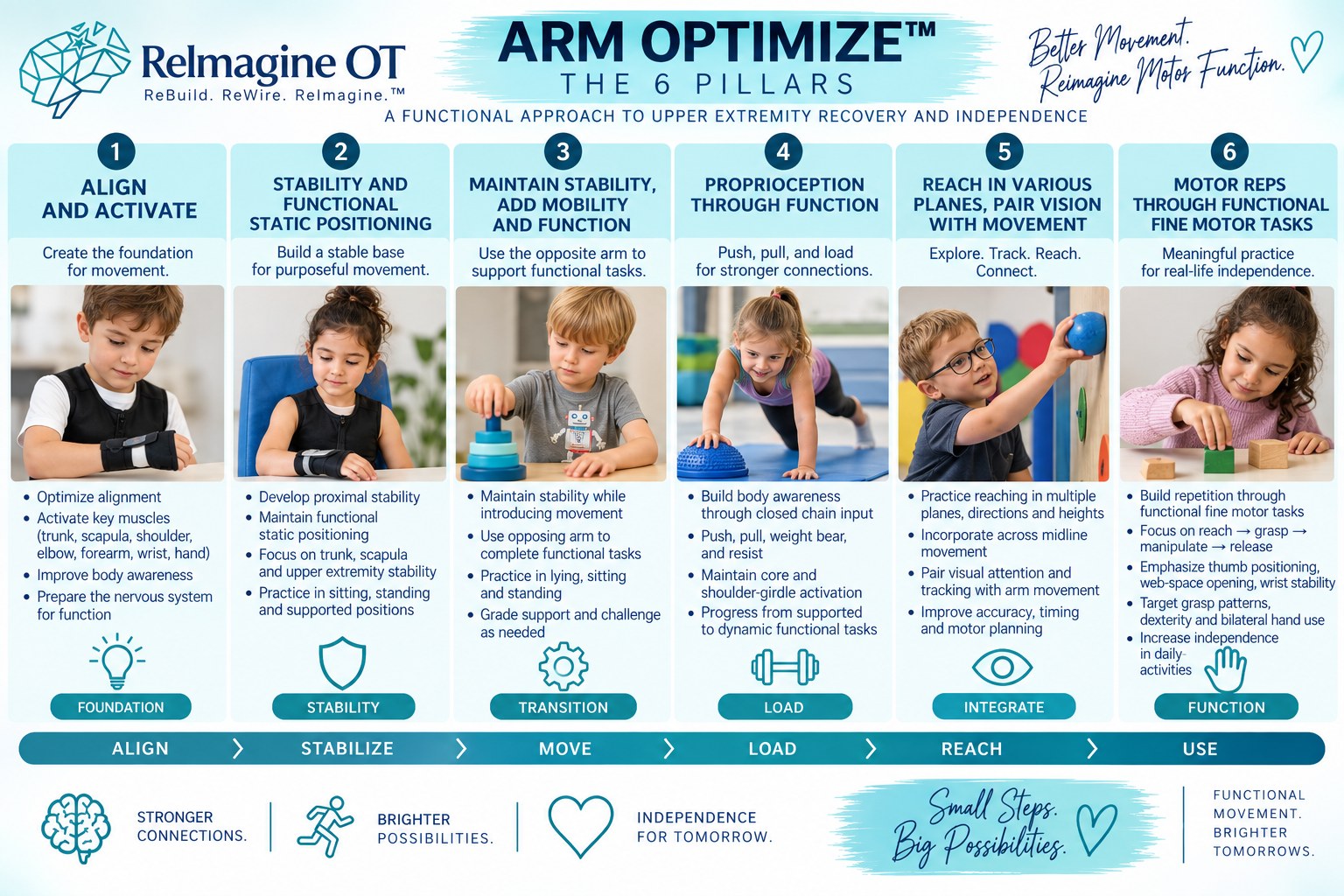
Six pillars, one sequence: align, stabilize, move, load, reach, use. Every technique in Arm Optimize™ sits on one of them.
ALIGN
STABILIZE
MOVE
LOAD
REACH
USE
1
Foundation
Align and Activate
Create the foundation for movement.
- Optimize alignment
- Activate key muscles: trunk, scapula, shoulder, elbow, forearm, wrist, hand
- Improve body awareness
- Prepare the nervous system for function
2
Stability
Stability and Functional Static Positioning
Build a stable base for purposeful movement.
- Develop proximal stability
- Maintain functional static positioning
- Focus on trunk, scapula, and upper extremity stability
- Practise in sitting, standing, and supported positions
3
Transition
Maintain Stability, Add Mobility and Function
Use the opposite arm to support functional tasks.
- Maintain stability while introducing movement
- Use the opposing arm to complete functional tasks
- Practise in lying, sitting, and standing
- Grade support and challenge as needed
4
Load
Proprioception Through Function
Push, pull, and load for stronger connections.
- Build body awareness through closed-chain input
- Push, pull, weight bear, and resist
- Maintain core and shoulder-girdle activation
- Progress from supported to dynamic functional tasks
5
Integrate
Reach in Various Planes, Pair Vision With Movement
Explore. Track. Reach. Connect.
- Practise reaching in multiple planes, directions, and heights
- Incorporate across-midline movement
- Pair visual attention and tracking with arm movement
- Improve accuracy, timing, and motor planning
6
Function
Motor Reps Through Functional Fine Motor Tasks
Meaningful practice for real-life independence.
- Build repetition through functional fine motor tasks
- Focus on reach → grasp → manipulate → release
- Emphasize thumb positioning, web-space opening, wrist stability
- Target grasp patterns, dexterity, and bilateral hand use
- Increase independence in daily activities
Clinical reference
Synergy & tone patterns
Understanding the patterns helps us break the patterns. Two reference guides for the presentations you see most.
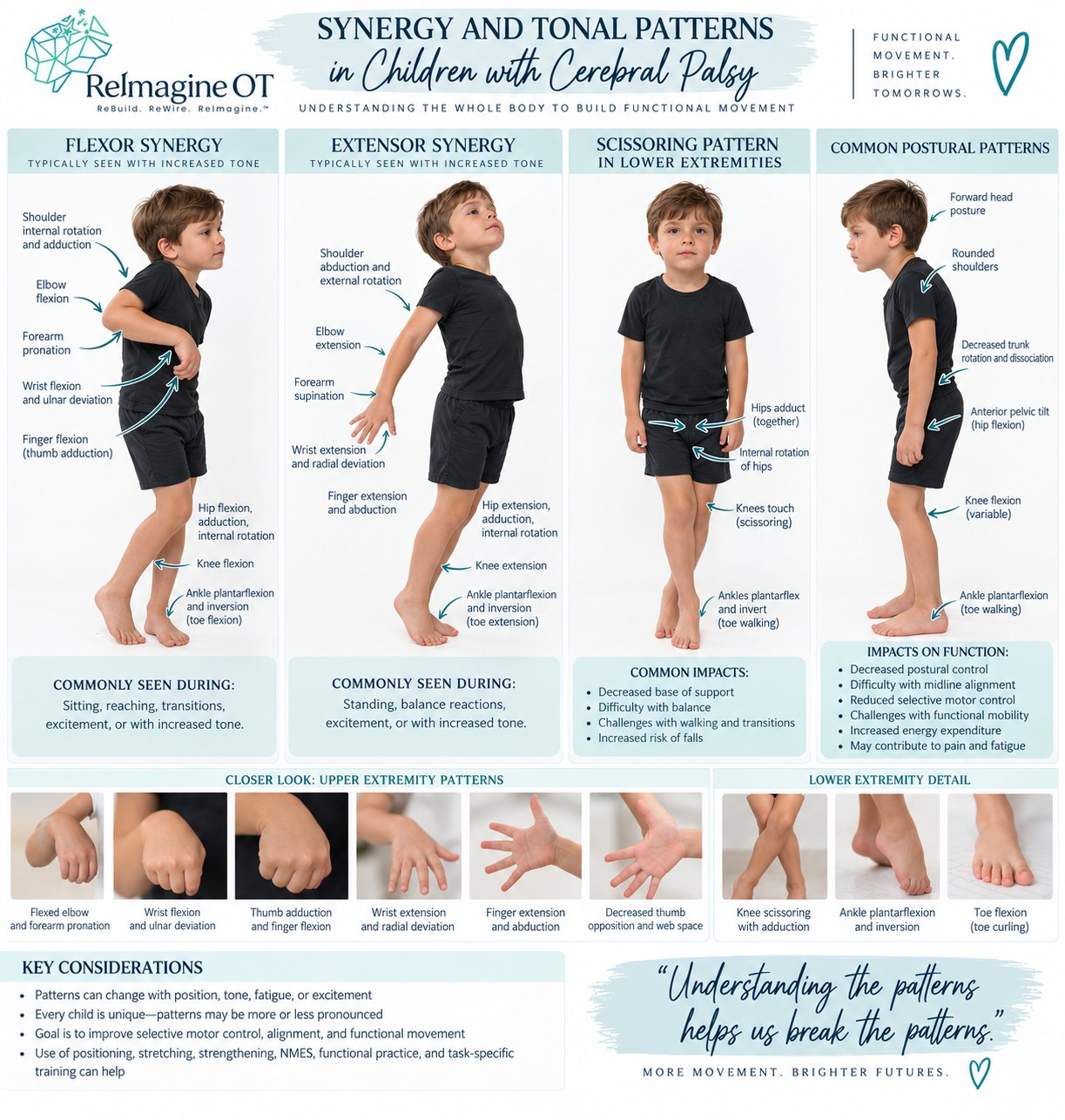
Synergy and Tonal Patterns in Children with Cerebral Palsy
Understanding the whole body to build functional movement
Flexor synergy (typically with increased tone)
- Shoulder internal rotation and adduction, elbow flexion, forearm pronation
- Wrist flexion with ulnar deviation, finger flexion with thumb adduction
- Hip flexion / adduction / internal rotation, knee flexion, ankle plantarflexion and inversion
- Commonly seen during sitting, reaching, transitions, excitement, or increased tone
Extensor synergy (typically with increased tone)
- Shoulder abduction and external rotation, elbow extension, forearm supination
- Wrist extension with radial deviation, finger extension and abduction
- Hip extension, knee extension, ankle plantarflexion and inversion
- Commonly seen during standing, balance reactions, excitement, or increased tone
Scissoring pattern in the lower extremities
- Hips adduct and internally rotate, knees touch, ankles plantarflex and invert
- Decreased base of support and difficulty with balance
- Challenges with walking and transitions; increased risk of falls
Common postural patterns and impact
- Forward head, rounded shoulders, anterior pelvic tilt, variable knee flexion
- Decreased postural control and midline alignment
- Reduced selective motor control and functional mobility
- Increased energy expenditure; may contribute to pain and fatigue
Key considerations
- Patterns change with position, tone, fatigue, or excitement
- Every child is unique — patterns may be more or less pronounced
- Goal: selective motor control, alignment, and functional movement
- Positioning, stretching, strengthening, NMES, and task-specific training all help
Understanding the patterns helps us break the patterns.